

How CBT Improves Sleep

When your mind won’t switch off at night
For many people, the hardest part of insomnia isn’t the tiredness; it’s the anxiety that shows up at bedtime.
You’re exhausted. You want to sleep. But as soon as your head hits the pillow, your mind does the opposite.
Thoughts race. Worries multiply. You start monitoring the clock and think to yourself, “If I don’t fall asleep soon, tomorrow will be a disaster.”
Night-time anxiety can turn sleep into something that feels tense, pressured, unpredictable and even frightening. Over time, your bed itself can become a place of stress rather than rest.
This is where CBT-based approaches for sleep can make a profound difference.
Not by forcing sleep. Not by controlling it. But by gently changing the thoughts, habits and responses that are keeping your nervous system on high alert at night.
In this post, we’ll explore:
Why anxiety and sleep are so tightly linked
How CBT-based approaches help calm night-time anxiety
The scientific evidence supporting CBT approaches for sleep
What actually changes when sleep starts to improve
Who this approach is especially helpful for
Why anxiety and sleep are so closely connected
Sleep is not something we do. It’s something that happens when the conditions are right.
The problem is that anxiety does the opposite of creating those conditions.
When you’re anxious, your nervous system shifts into threat mode:
Heart rate increases
Muscles stay tense
Attention becomes hyper-focused
The brain scans for danger
This response is brilliant if you’re crossing a busy road or facing a real threat. But it’s much less helpful at 2 a.m.
Over time, many people with insomnia develop:
Anxiety about not sleeping
Fear of how they’ll cope the next day
Pressure to “make sleep happen”
Hyper-awareness of bodily sensations at night
Sleep becomes something to try for, rather than something to allow.
CBT-based sleep approaches are designed to gently reverse this process.
What do we mean by CBT-based approaches for sleep?
CBT stands for Cognitive Behavioural Therapy, but in the context of sleep, it’s often more practical and down-to-earth than people expect.
CBT-based approaches for sleep focus on three main areas:
1. Thoughts
The beliefs, worries and predictions that show up at night:
“I’ll never sleep properly again”
“If I don’t sleep, I won’t cope”
“Something must be wrong with me”
2. Behaviours
The habits that quietly keep insomnia going:
Lying awake in bed for hours
Clock-watching
Trying to “catch up” on sleep
Avoiding activity due to fatigue
3. Physical responses
The tension, alertness and stress response that make sleep difficult:
Shallow breathing
Tight muscles
A racing or restless body
CBT-based sleep work doesn’t judge these responses, rather it helps you understand and gently change them.
How night-time anxiety develops (and why it’s not your fault)
Many people feel frustrated with themselves for feeling anxious at night. Have you ever said to yourself, “Why can’t I just relax?” or “Everyone else seems to sleep without thinking about it.” These thought processes are very common when you have insomnia.
But night-time anxiety is not a personal failing. It’s a learned response.
If you’ve had repeated nights of poor sleep, your brain starts to associate:
Bed = wakefulness
Night = struggle
Lying down = danger
This is classic conditioning. It’s the same process that makes us flinch at a loud noise or feel nervous before an exam. We just do it automatically because this is how our bodies naturally respond to threat.
CBT-based approaches help us unlearn unhelpful associations and replace them with calmer responses.
How CBT approaches to sleep reduce night-time anxiety
1. Taking the pressure off sleep
One of the biggest drivers of sleep anxiety is trying too hard. CBT-based work helps shift from:
“I must sleep or tomorrow will be awful”
to:
“My body knows how to sleep and I’m creating the right conditions for it.”
This change alone can reduce night-time tension significantly.
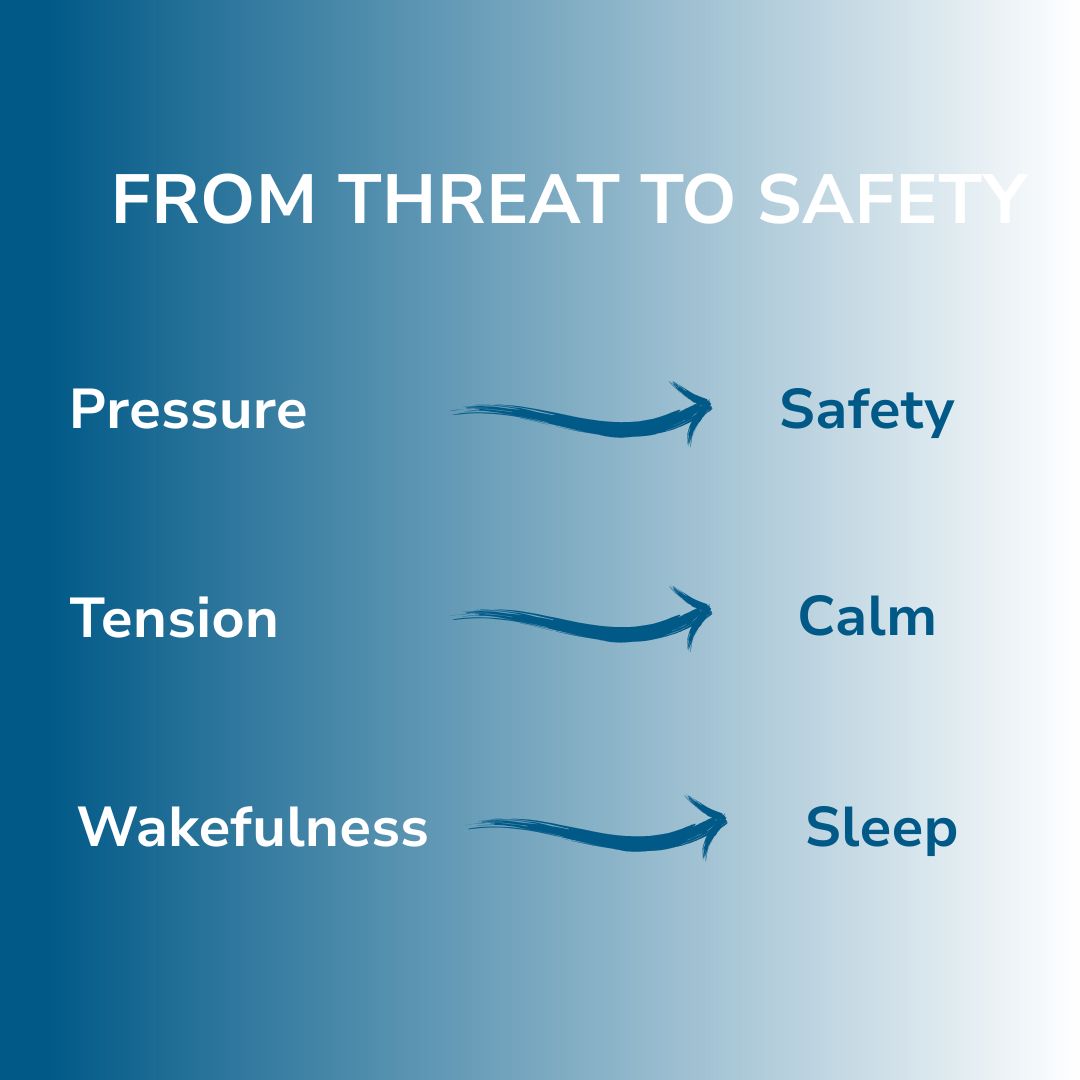
Sleep returns when the nervous system feels safe.
2. Changing unhelpful sleep thoughts
CBT helps us gently question thoughts that feel true at 3 a.m. but aren’t actually facts.
This isn’t about positive thinking; it’s about realistic, compassionate thinking.
Over time, the mind becomes less reactive at night.
3. Making the bed a place of rest
If you spend hours awake in bed, your brain learns that the bed is for thinking, worrying and waiting.
CBT-based sleep strategies help:
Break this association
Strengthen the link between bed and rest
Reduce alertness at bedtime
This can feel counter-intuitive at first but it’s one of the most powerful shifts for chronic insomnia.
4. Reducing Hyper-Monitoring and Clock-Watching
Many people with sleep anxiety become experts at monitoring:
How long they’ve been awake
How their body feels
How tired they expect to be
CBT-based approaches help loosen this monitoring, which reduces anxiety and allows sleep to emerge more naturally.
5. Supporting the Nervous System to Settle
CBT-based sleep work often includes:
Gentle regulation techniques
Awareness of physical tension
Ways to signal safety to the body
When the body feels safer, the mind follows. This is where CBT often works beautifully alongside hypnotherapy.
The paradox of sleep – why trying less often helps more
One of the most surprising things people learn in CBT-based sleep work is that trying harder to sleep often makes sleep harder to come by.
Sleep is governed by something called sleep pressure. This is a natural biological drive that builds the longer you are awake. Just like hunger increases the longer you go without eating, sleep pressure increases the longer your brain has been awake and active.
The difficulty is that anxiety interferes with this process.
When you’re worrying about sleep, clock-watching or forcing rest, your nervous system stays on alert. This alertness blocks sleep pressure from doing its job.
CBT-based approaches work with sleep pressure rather than against it. They reduce behaviours and habits that dilute it, and gently remove the pressure and fear that keep the brain switched on at night.
This can feel counterintuitive at first but it’s one of the reasons the approach is so effective.
What the research shows (and why this matters)
This paradoxical approach isn’t just theoretical; it’s strongly backed by research.
Sleep expert Professor Matthew Walker summarises the evidence clearly in his bestselling book Why We Sleep:
“Results, which have now been replicated in numerous clinical studies around the globe, demonstrate that CBT-I is more effective than sleeping pills in addressing numerous problematic aspects of sleep for insomnia sufferers.”
In the same chapter, Walker explains that a landmark report in the Annals of Internal Medicine concluded that CBT-I should be the first-line treatment for chronic insomnia, not sleeping pills.
Why?
Because:
The benefits of CBT-I are greater and longer-lasting
Improvements continue after treatment ends
Sleeping pills often lead to rebound insomnia when stopped
In other words, CBT-based sleep therapy doesn’t just help you sleep now, it helps reset the system so sleep becomes more stable over time.
Why this feels so different from “sleep tips”
Many people come to therapy having tried everything:
Supplements
Apps
Strict routines
Forcing early bedtimes
CBT-based sleep work doesn’t pile on more effort. Instead, it removes the things that are getting in the way of sleep pressure doing its job.
As anxiety reduces and the system settles, sleep often begins to return. This is not because sleep is being chased, but because it’s being allowed.
What changes when sleep anxiety starts to ease
Clients often tell me they notice changes before their sleep improves more radically.
Things like:
Less dread around bedtime
Fewer racing thoughts at night
A calmer response after a poor night
More confidence in their ability to cope
Sleep starts to feel less fragile and from there, real improvement becomes possible.
Who CBT for insomnia is particularly helpful for
CBT-based sleep therapy tends to work especially well if:
Your sleep problems are linked to stress or anxiety
You feel “tired but wired” at night
Your mind is busy rather than sleepy
You’ve tried lots of sleep tips without success
You want practical tools, not endless analysis
It’s also well suited to people who like to understand why something works, not just what to do.
What CBT-based sleep therapy is not
It’s worth clearing up a few myths.
CBT-based sleep work is not:
Being told to “just relax”
Following rigid rules forever
Forcing sleep to happen
Ignoring emotional or physical needs
Instead, it’s a collaborative, thoughtful process that adapts to you.
A word of reassurance
If you’re struggling with night-time anxiety, it can feel as though your sleep system is broken. It isn’t.
Your body still knows how to sleep. It just needs the right conditions, and often, a bit of guidance, to remember how.
CBT-based approaches don’t promise instant perfection. They offer something more realistic and sustainable: calmer nights and a gradual return of trust in sleep.
Key Takeaways
Night-time anxiety is a learned response, not a failure
CBT-based approaches address thoughts, behaviours and physical responses
Reducing pressure around sleep is often the first big shift
Huge amounts of scientific evidence prove its effectiveness
Calmer nights usually come before “perfect” sleep
With the right support, sleep can become something you stop fighting
Enjoying restorative sleep shouldn’t feel like a battle.
If insomnia or sleep anxiety are wearing you down, gentle, personalised sleep therapy can help you feel calmer at night and more confident in your sleep again. Click here to contact me to arrange a free 30-minute call or video call to discuss what’s been happening and how I can help.