

Is Your Bedtime Routine Feeding Your Sleep Anxiety?

If you struggle with bedtime anxiety, chances are you’ve tried to fix it by doing more.
More routines. More rules. More tracking, tweaking, optimising and monitoring.
Ironically, this well-intentioned effort can end up making night-time anxiety worse.
Many people I work with tell me that evenings have become a performance: the perfect wind-down routine, the right supplements, the correct breathing pattern, all carefully designed to finally make sleep happen.
And yet, the harder they try, the more anxious bedtime feels.
A metaphor that might feel familiar
Imagine trying to fall asleep is like trying to fall in love.
You can set the scene by dimming the lights, putting on music and creating the perfect conditions. But the moment you start checking whether it’s working, something shifts. It becomes effortful. Forced. Awkward.
Sleep works in a similar way.
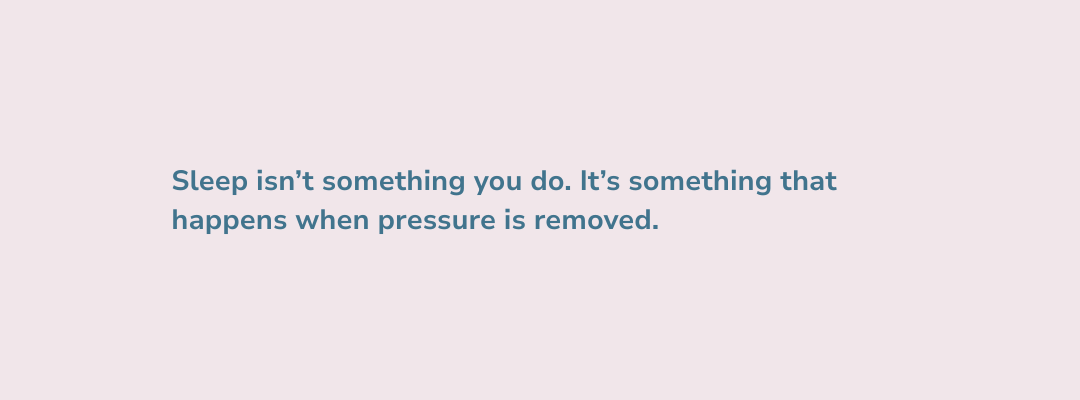
It’s a natural biological process, not a task to be completed. When your bedtime routine becomes something you have to get right, it can turn into a sleep anxiety trigger rather than a source of calm.
How bedtime routines can accidentally increase anxiety
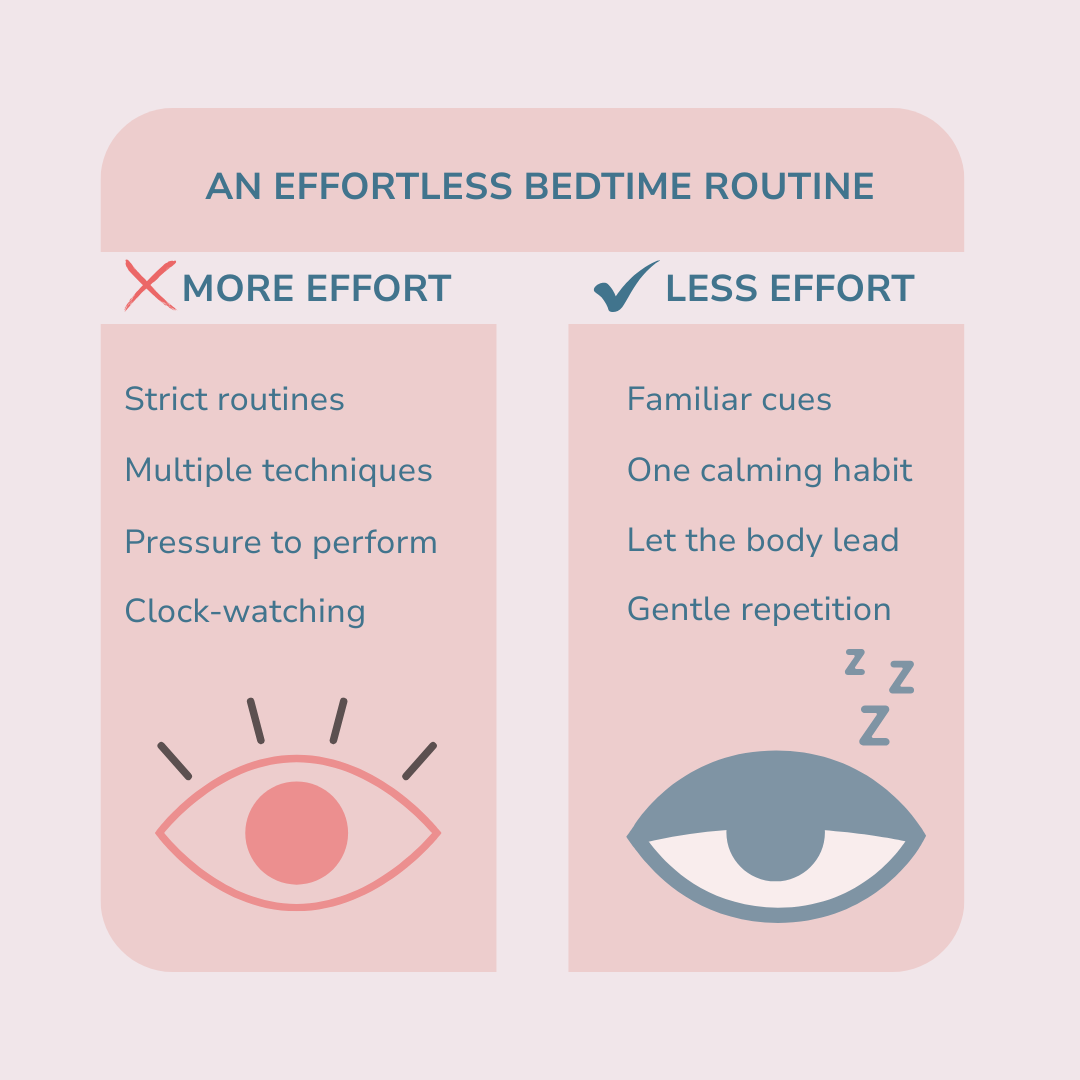
A routine for better sleep is often recommended for good reason. Consistency and predictability can help the nervous system feel safer.
But problems arise when routines become:
Rigid rather than supportive
Loaded with pressure (“If I don’t do this, I won’t sleep”)
Focused on controlling sleep rather than inviting rest
At that point, the routine starts signalling threat, not safety. Instead of winding down, your mind may start scanning:
Am I relaxed enough yet?
Why isn’t this working tonight?
What if I don’t sleep again?
This is where anxiety before bed starts to take hold.
Why fear of going to bed develops
For many people, bedtime itself becomes the problem.
After repeated nights of lying awake, worrying, clock-watching or feeling wired, the brain learns an unhelpful association:
Bed = effort, frustration, alertness
This is why fear of going to bed is so common in sleep anxiety. It’s not that people are afraid of sleep: they’re afraid of what usually happens in bed.
From a cognitive behavioural perspective, this is a learned pattern. Your nervous system is doing what it evolved to do: preparing you for something it thinks might be difficult or threatening.
And the more you try to counteract that with effort, the louder the system can become.
Less effort, more safety: a CBT-informed shift
CBT techniques for bedtime anxiety don’t aim to create the perfect routine.
Instead, they help you:
Reduce monitoring and self-checking
Loosen rigid bedtime rules
Shift attention away from “trying to sleep”
Rebuild a sense of safety around bed and night-time
In other words, CBT works by removing fuel from the anxiety–sleep loop, rather than adding more strategies to manage.
This is often a huge relief for people who feel exhausted by “doing sleep right”.
Signs your routine might be feeding sleep anxiety
You might recognise yourself here if:
You feel anxious if your routine is disrupted
You spend evenings worrying about how tonight will go
You avoid going to bed until you’re utterly exhausted
You feel pressure to feel calm before you’re “allowed” to sleep
You lie in bed analysing whether your routine has worked
These aren’t failures: they’re clues.
They suggest your nervous system needs permission to rest, not more instructions.
What to do instead
Rather than scrapping your routine entirely, consider softening it.
Think supportive cues, not strict rules.
Helpful shifts might include:
Allowing flexibility rather than perfection
Letting the routine signal “nothing else is required of you”
Choosing activities that absorb attention lightly (not force relaxation)
A kinder way to think about bedtime
If bedtime anxiety is present, something in you is trying to help, even if it doesn’t feel that way.
Your system isn’t broken. It’s over-protective.
The goal isn’t to eliminate anxiety before bed, but to stop organising your evening around it.
When bedtime becomes less important, less evaluated and less effortful, sleep is given space to return.
Key takeaway
A routine for better sleep should make life simpler, not smaller.
If your bedtime routine feels like a test you might fail, it may be feeding sleep anxiety. With the right support, which includes CBT-based adjustments and hypnosis techniques for sleep, you can move away from effort and back toward ease.
Looking for help with your bedtime routine?
You don’t have to figure it out alone. Sleep therapy can help you step out of the anxiety–effort cycle and rediscover a calmer relationship with sleep. Click here to arrange a free 30-minute consultation with me to talk things through, without pressure or commitment.