

Why You Can’t Sleep Even When Exhausted

If you’ve ever whispered “I can’t sleep even when I’m tired” into the dark at 3 am, you’re not alone.
This is one of the most distressing parts of insomnia: crushing exhaustion paired with a mind and body that refuse to power down. You feel exhausted… yet alert. Drained… yet buzzing. It’s the classic tired but wired feeling.
For many people, this experience is driven by hyperarousal insomnia. This is a state where the body’s threat systems are stuck in “on” mode, even when you’re safe, still and ready for rest.
The nervous system and body chemistry
Our nervous system plays a key role in sleep. When it’s overactive or dysregulated, sleep becomes difficult – like an oversensitive smoke alarm that goes off every time you make toast.
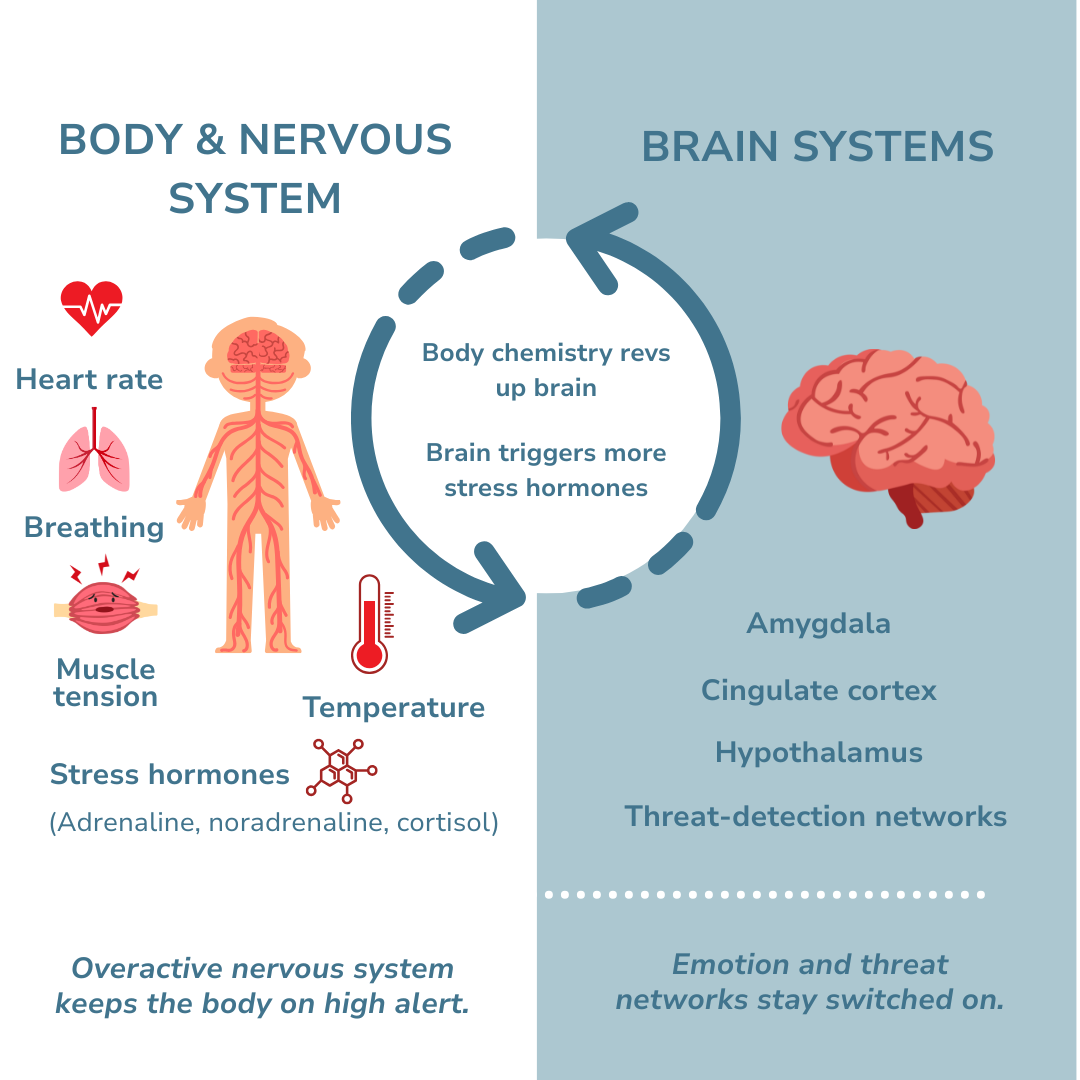
The sympathetic branch of the autonomic nervous system (your fight-or-flight system) is especially important here. When overactive, it triggers the release of stress hormones like adrenaline and noradrenaline, along with subtle metabolic changes that keep you feeling restless and on edge.
Night-time cortisol spikes
Cortisol, the body’s main stress hormone produced by the adrenal glands, also plays a role. In healthy sleepers, cortisol naturally dips at night.
In insomnia, however, cortisol may start to fall but then spikes as soon as you get into bed. These night-time surges help explain why people wake repeatedly and contribute to the insomnia exhaustion cycle: tired all day, wired all night.
A brain that won’t power down
Sleep is fundamentally a brain activity. In insomnia, the brain behaves like a laptop that keeps running even after you shut the lid.
· Emotion-processing areas like the amygdala and cingulate cortex stay active, fuelling overthinking at night.
· The hypothalamus, our sensory gatekeeper, struggles to block out noise, light and internal sensations.
· The salience network, the brain’s threat-detection system, keeps scanning for danger, even when your body is desperate for rest.
The feedback loop
It’s basically a feedback loop: body chemistry hits the gas, the brain revs even higher, which then triggers more chemical activity – and the cycle keeps running, resulting in a frustrating hyperarousal loop.
Knowledge = reassurance
It’s easy to feel overwhelmed by all the science behind sleep but understanding what’s happening in your body and brain can actually be empowering. Insomnia isn’t “all in your head” – it’s a real, medical condition involving both brain and body. Recognising that can help you stop minimising your experience and take the steps to get support. Most importantly, insomnia is reversible. Once your system learns it’s safe to rest, sleep naturally follows.
If you’re stuck in the “tired but wired” loop and wondering if sleep will ever feel natural again, you don’t have to figure this out alone.
I offer a free 30-minute discovery call where we can talk through what’s been happening with your sleep, explore what might be keeping your system on high alert and see whether working together feels like a good fit. Click here to get in touch via the contact form.
There’s no obligation – just a supportive conversation to help you take the next step.