

Why Anxiety Stops You Sleeping
If you’ve ever felt exhausted all day, only to lie awake at night with your mind racing, you’re not alone. One of the most frustrating things about anxiety is how it seems to save its loudest voice for bedtime.
During the day, you might cope. You get through work, conversations and tasks. But at night, when the lights go out and the world gets quiet, anxiety can suddenly feel overwhelming. Thoughts speed up. Your body feels tense or alert. You’re tired, yet somehow wired.
Anxiety stopping sleep is one of the main reasons insomnia develops in the first place. Sleep isn’t lost because the body forgets how to rest. It’s lost because an overactive alert system keeps sounding signals long after the danger has passed.
If this sounds familiar, there is nothing wrong with you and you are not failing at sleep.
Why anxiety feels worse at night
Anxiety before bed is incredibly common, and there are good reasons for it.
During the day, our minds are busy responding to the outside world. At night, those distractions fade. There’s more space for thoughts, worries and internal sensations to take centre stage.
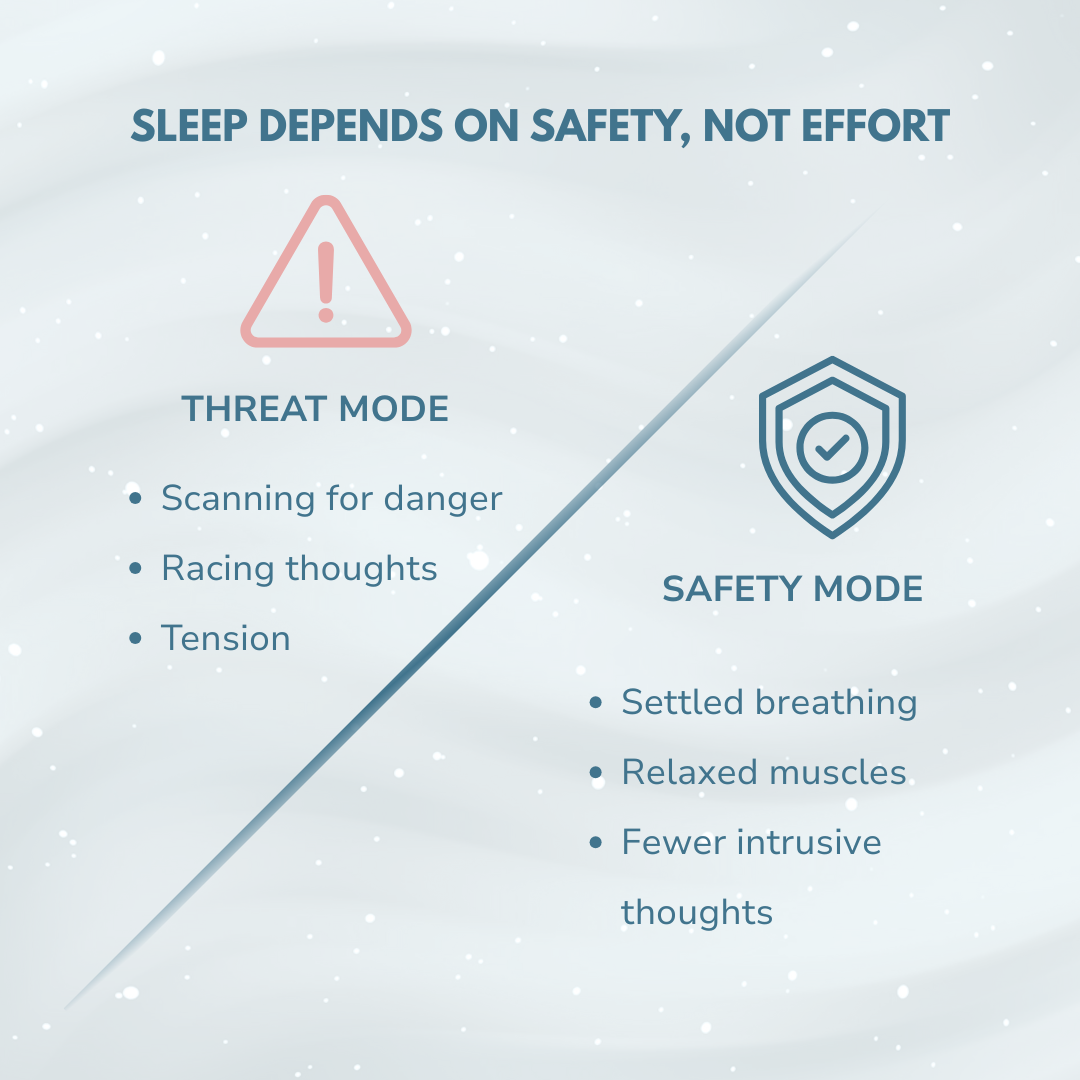
At the same time, our nervous systems don’t automatically switch off just because we want to sleep. If you’ve been under stress, dealing with uncertainty or worrying about sleep itself, your system may still be in alert mode, scanning for problems rather than allowing rest.
This is why so many people ask themselves:
Why can’t I sleep even when tired?
Why do my thoughts race at night?
Why does worry before sleep feel so intense?
It’s not a lack of willpower. It’s a nervous system that hasn’t yet learned that night-time is safe.
Why sleep has always depended on safety
Long before duvets, bedrooms and blackout blinds, sleep was a collective survival activity.
Our ancestors rarely slept alone. In early human groups, people took turns keeping watch while others rested. Sleep happened in shared spaces, with trusted others nearby, because closing your eyes meant becoming vulnerable. If danger approached, someone else’s alertness kept you safe.
This matters because the human nervous system hasn’t forgotten that.
At a biological level, sleep is only permitted when the brain senses safety. If your mind believes there is a threat, whether that threat is a predator in the dark or a feared night of wakefulness, the body stays alert. From an evolutionary perspective, this isn’t a flaw. It’s a protective feature.
So when anxiety ramps up at night, it isn’t your system “malfunctioning”. It’s your ancient alarm doing exactly what it evolved to do: keeping you awake when safety feels uncertain.
The problem is that modern threats now tend to be internal rather than external. Instead of listening for footsteps outside the cave, the brain scans thoughts and sensations, and keeps you awake in the process.
Understanding this can be deeply reassuring. Sleep doesn’t come from forcing yourself to switch off. It comes from helping your nervous system feel safe enough to let go.
The anxiety–sleep loop
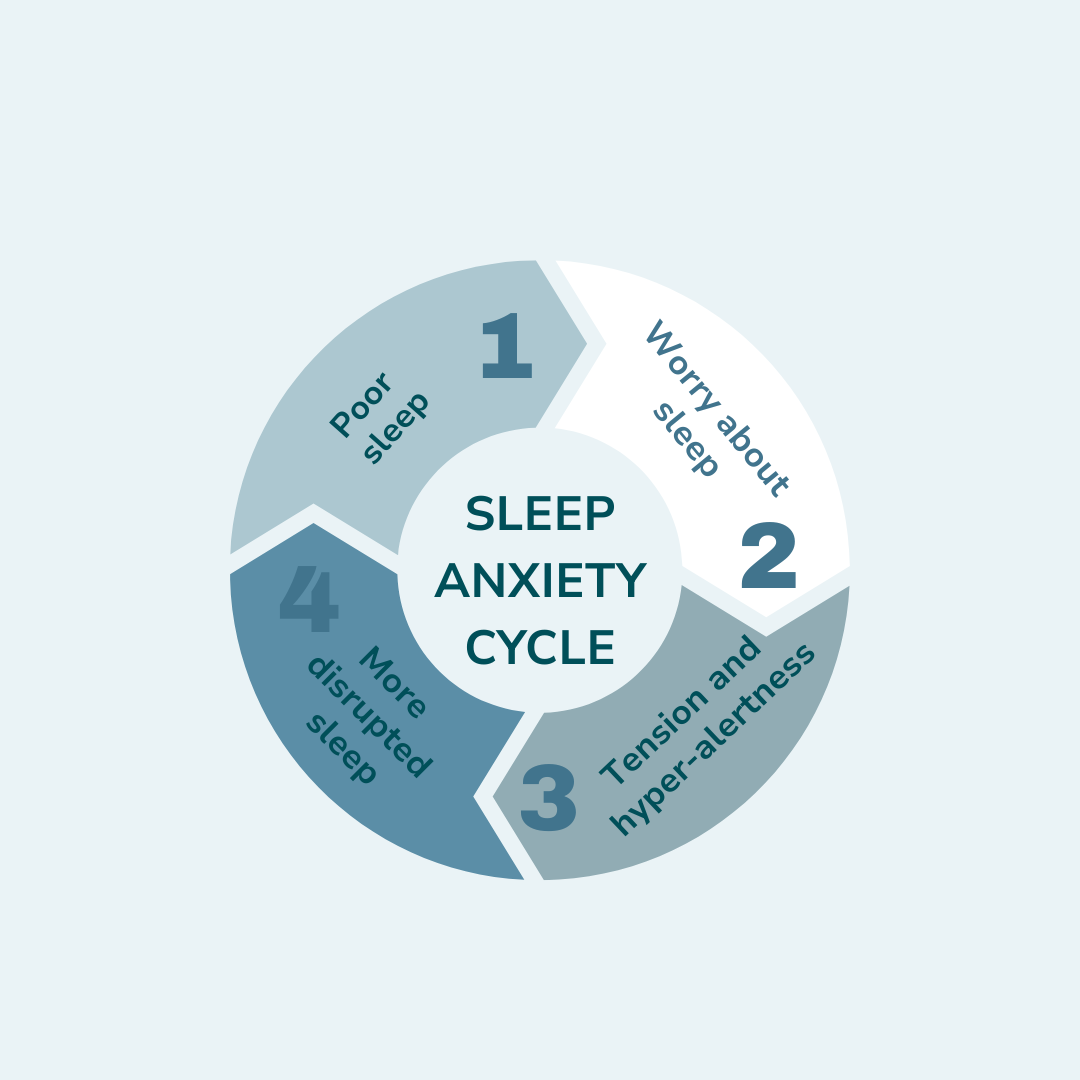
Over time, this can turn into a self-reinforcing pattern, often called the anxiety sleep loop or night-time worry cycle:
You struggle to sleep
You start worrying about not sleeping
That worry increases alertness in the body
Increased alertness makes sleep even harder
The bed itself becomes associated with anxiety
Once this loop is established, bedtime anxiety can feel automatic, as though your body reacts before you even have a chance to think.
The good news is that learned patterns can be gently unlearned.
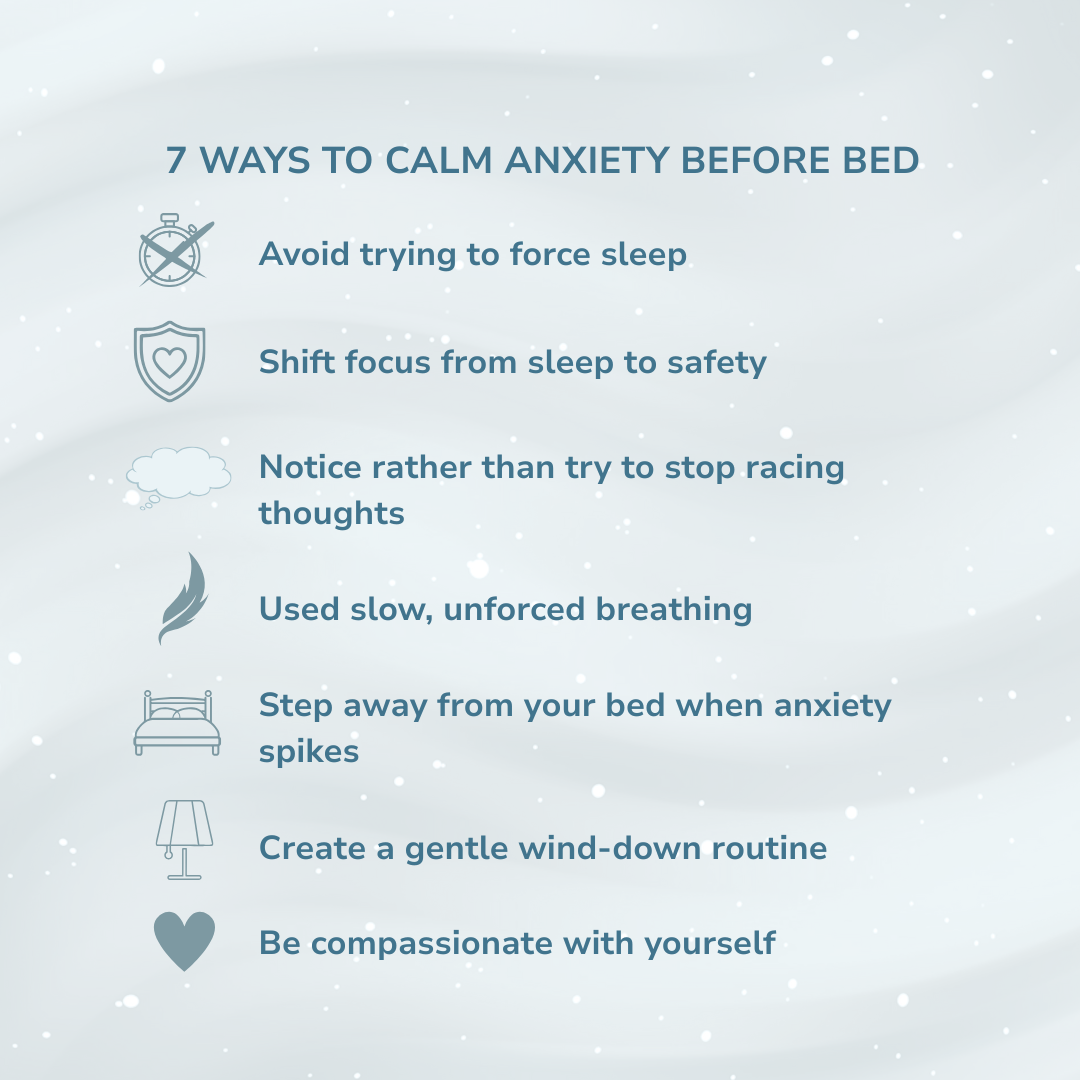
7 gentle ways to calm anxiety before bed
These aren’t “quick fixes” or things you need to do perfectly. Think of them as ways of sending your nervous system a quieter, kinder message.
1. Stop trying to force sleep
The harder you try to sleep, the more pressure you create. Sleep is not something you do. It’s something that happens when conditions are right. Letting go of the struggle is often the first step.
2. Shift focus from sleep to safety
Instead of asking, “Will I sleep?”, try asking, “What helps my body feel safer right now?” Anxiety settles when the nervous system feels safe, not when it feels monitored.
3. Soften racing thoughts rather than stopping them
Racing thoughts at night don’t need to be eliminated. Gently acknowledging them by saying to yourself, “My mind is busy right now”, can reduce the internal battle that keeps anxiety alive.
4. Use slow, unforced breathing
Longer exhales signal safety to the nervous system. There’s no need for complex techniques. Simply letting your out-breath be slower than your in-breath can help reduce bedtime anxiety.
5. Change your relationship with the bed
If your bed has become a place of tension, it can help to step away briefly when anxiety spikes. This isn’t failure. It’s teaching your brain that the bed isn’t a battleground.
6. Create a wind-down buffer
Anxious systems need time to downshift. Gentle routines, such as dim lighting, quieter activities, predictable rhythms, help your body recognise that night is approaching.
7. Be compassionate with yourself
Perhaps the most important step. Anxiety at night often comes with self-criticism: “Why can’t I just sleep like everyone else?” But anxiety isn’t a flaw. It’s a protective system that’s working too hard.
You’re not broken
If anxiety is stopping you sleeping, it doesn’t mean you’re weak, dramatic or beyond help. It means your nervous system has learned to stay alert at night, and often for understandable reasons.
With the right support, this pattern can change. Sleep can become less effortful. Nights can feel calmer again.
You don’t have to fight your anxiety to sleep. You can learn how to work with your body instead.
Stuck in the anxiety–sleep loop?
Sleep therapy helps calm the nervous system, change unhelpful patterns and gently guide the body back into rest.
If this resonates with you, I’d love you to get in touch via my contact page to arrange a free, no-obligation 30-minute chat. We can talk through what’s been happening with your sleep, what’s been most difficult and how I may be able to support you.
This is a relaxed, pressure-free way to see whether the gentle, evidence-based approach I offer feels like a good fit for you.